
The short version
| A family vacation shirt works when one element is shared and everything else is free to vary. That element can be a colour, a slogan format, or a fandom. Matching the whole shirt exactly is what makes people refuse to wear it. Give each person their own line or their own character, keep the colour or the theme constant, and the shirts get worn more than once. |
Search for family vacation shirts and you will find a thousand designs, with almost no guidance on how to choose between them, which is the actual problem worth solving here.
This guide covers 25 ideas grouped by type, the five decisions that narrow them down, and an honest comparison of custom versus ready-made. It also covers something the other guides skip entirely: how little sun protection a plain cotton shirt actually gives you.
The shirts that get worn all week all share one trait, which is that they unify the group without erasing the individual. That balance is the whole design problem in a single sentence.
A shirt that is identical down to the last letter turns a family into a uniform. Teenagers in particular will find a reason not to wear it, and they are usually right to.
So pick one constant and let everything else move, whether that constant is the colour, the layout, the joke format or the fandom. Any one of those reads clearly in a photograph.
| The test to apply before you order: Would the least enthusiastic person in the group wear this in an airport? Does each person get something that is theirs, not just a copy of everyone else’s? Is it still wearable in November, or is it landfill on the flight home? Can you spot it across a crowded pool deck from twenty metres? |
Most people start by browsing designs, which is why the process drags on for weeks. Settle these five things first and the design choice takes about ten minutes.
| Decision | The practical version | Why it matters |
|---|---|---|
| 1. Theme | Destination, joke, roster, colour, or fandom. Pick one lane. | Mixing two themes is what produces a cluttered shirt nobody likes. |
| 2. Colour | One shade for everyone, or a graded set within one family. | Colour does more work in photos than any print. It also affects sun protection. |
| 3. Text | Same line for all, or a personal line each. | Personal lines are the single biggest lift in how often shirts get re-worn. |
| 4. Fit | Unisex is simplest. Mixed fits need a size chart everyone actually reads. | Sizing is the most common reason a custom order goes wrong. |
| 5. Budget | Per-shirt cost times the group, plus shipping and a spare. | Custom pricing drops sharply with quantity. Small groups pay the most per shirt. |
Answer these in order. Each one narrows the next.
The spare shirt is always worth the money. Somebody will spill something on day one, and a replacement bought at the destination will never match the rest of the set.
These are grouped by type rather than ranked in any order of merit. Find the group that fits your family and pick from inside it, because the six do not mix well.
This is the most common approach, and also the one most likely to look generic. All five below avoid the usual default of printing a place name in a very large font.
Vacation humour ages badly, so the safest jokes are the ones about your own family rather than about the destination. These six survive the flight home intact.
| A caution on jokes about the destination: humour that lands at home can read differently where you are going. Jokes about your own family travel safely, because you are the only target. |
This is sports-team logic applied to a family, and it solves the individuality problem cleanly, since everyone is visibly on the same team while still being recognisably themselves.
This is the cheapest option on the list, and often the best-looking one. No print at all means no minimum order, no proofing round and no lead time to manage.
| Colour is doing more than decoration here. Dark and bright shades absorb ultraviolet rather than letting it through, so a deep colour is measurably better sun cover than a pale one. More on that below. |
This is the one place where a ready-made shirt genuinely beats a custom one. A family that already shares a fandom, or just a sense of humour, has something doing the unifying work for free.
The practical advantage is that these carry on being worn long afterwards. A shirt printed with a date and a place has one season in it, while a design somebody genuinely likes has years.
Every group has at least one person like this, and forcing the issue only produces a photo where somebody looks visibly annoyed. It is far easier to lower the bar.
Cruises have their own conventions, largely because the ship gives you a shared setting that everyone on board recognises immediately.
| Idea | Why it works on a ship |
|---|---|
| The ship name and sail year | Other passengers on the same sailing will notice, and that is half the fun. |
| Nautical stripes, no print | Reads as cruise without committing to a slogan. Works in the dining room too. |
| A boarding-day joke | Embarkation day is the shared experience. Muster drill jokes land with everyone. |
| Cabin numbers on the back | Genuinely useful with kids, and it looks like a design choice rather than a label. |
| One colour per formal night | Cruises schedule dress-up nights. A colour plan turns an obligation into a bit. |
Five that work because the ship is already doing half the explaining.
One practical note on fabric weight. Ship air conditioning runs cold indoors while the pool deck stays hot, so a mid-weight shirt beats a very light one.
A vacation shirt gets worn outdoors, all day, for a week, which makes it sun protection whether you chose it that way or not. Most matching shirts are quite poor at that job.
Fabric is rated by UPF , or Ultraviolet Protection Factor. The Skin Cancer Foundation explains that UPF measures how much ultraviolet radiation gets through fabric to reach your skin, counting both UVA and UVB. The SPF rating on a bottle of sunscreen covers UVB alone.
| An ordinary white cotton t-shirt gives roughly UPF 5 to 7, and drops to about UPF 3 once it is wet. A fabric needs UPF 50 to carry the Skin Cancer Foundation’s Seal of Recommendation, which blocks 98 percent of ultraviolet rays. A plain white matching tee at a pool is therefore close to no protection at all. |
That range is a range for a reason. The Skin Cancer Foundation puts a white t-shirt at about 7 , while Cleveland Clinic quotes a dermatologist giving most cotton shirts an equivalent of about 5 . We have given both rather than picking one, and either way the number is far lower than most people assume.
| Choice | Effect on sun protection | What to do about it |
|---|---|---|
| Colour | Dark and bright shades absorb ultraviolet instead of letting it pass through. | A navy or deep red group shirt beats white or pastel on protection. |
| Weave | Densely woven cloth blocks more than thin or loosely woven cloth. | Hold it up to a light. If you can see through it clearly, so can the sun. |
| Wet or dry | Wet cotton loses roughly half its already low rating. | Assume a swim shirt is doing almost nothing once it is soaked. |
| Fibre | Unbleached cotton has natural UV absorbers; shiny polyesters can rate highly. | For real water days, buy something rated UPF 50, not a printed cotton tee. |
Factors drawn from the Skin Cancer Foundation and Cleveland Clinic .
None of this means you should skip the matching shirts altogether. It means choosing a darker colour where you can, and not treating the shirt as your whole plan for a full day at the beach.
This is the decision most other guides skip, largely because they sell custom printing. The honest answer is that both options are correct in different situations.
| Custom printed | Ready-made designs | |
|---|---|---|
| Lead time | Two to six weeks including proofing and shipping | Standard delivery, no proofing step |
| Minimum order | Often applies, and per-shirt price falls sharply with quantity | None. Buy one or eleven |
| Cost per shirt, small group | Highest. Setup is spread across very few shirts | Flat, whatever the group size |
| Design control | Total. Names, dates, inside jokes, rosters | None. You pick from what exists |
| Sizing across ages | One order, but a sizing mistake is expensive to fix | Each person picks their own size and fit |
| If someone drops out | You have paid for the shirt | You have not ordered it yet |
| Worn after the trip | Rarely, if it carries a date and a place | Often, because it was chosen on merit |
Neither column wins outright. The group size and the theme decide it.
| Which one you actually needGo custom for rosters, names, inside jokes, reunions, or any group above about eight people. Go ready-made for small families, short lead times, mixed ages and sizes, or any group that already shares a fandom. Do both for a large reunion: custom for the shared photo day, ready-made for the rest of the week. |
| Worth saying plainly: RIPT does not do custom printing. We print our own artists’ designs and sell them ready-made. So if your idea needs names on the back, the section below is how to brief someone who can do it properly. |
This is where a shirt company’s experience is genuinely worth something to you, even when the order itself is going somewhere else entirely. Four things decide whether the shirts survive the week and the wash after it.
Most complaints about custom shirts trace back to the printing process, not the artwork. The three common methods behave very differently from one another.
| Method | Best for | The trade-off |
|---|---|---|
| Screen printing | Larger runs, one to three flat colours, maximum durability | Setup cost per colour, so small orders get expensive fast |
| Direct-to-garment | Small runs, photographic detail, many colours | Water-based inks suit natural fibres; less hard-wearing than a cured screen print |
| Heat transfer vinyl | Names and numbers on the back, one-offs | Application quality decides everything. Poorly pressed vinyl peels early |
Ask which method a printer is quoting before comparing prices between them.
For a run of matching shirts in one or two colours, screen printing is the durable choice. Screen printing pushes ink through a stencilled mesh, one screen per colour, which is why the setup cost rises with each colour used.
For a small family group with a detailed, multi-coloured design, direct-to-garment makes more sense. The technical description of direct-to-garment printing notes that it prints a single shirt at minimal cost with no long setup, and that its water-based inks work best on natural fibres such as cotton.
| Be sceptical of exact durability claims. Most “lasts 50 washes” figures come from companies selling that specific method, and there is no neutral standard behind them. The reliable ordering is that a properly cured screen print outlasts direct-to-garment, and that vinyl depends almost entirely on how well it was pressed. |
The blank a printer uses matters far more than most people expect. A cheap, heavy cotton blank is usually the reason nobody wears the shirt again once the trip ends.
Ask which blank is being used and then look it up yourself. Weight is quoted in ounces or GSM, and lighter is generally better in hot weather, up to the point where it turns see-through.
Blends behave differently again, and the difference is worth understanding before you choose. Our guide to what a tri-blend shirt is covers why a cotton, polyester and rayon mix drapes softer and dries faster than pure cotton, which matters on a hot week.
Sizing is where family orders go wrong, because one person guesses on behalf of everyone and the shirt arrives unwearable. Collect actual measurements rather than estimates.
Six weeks before travel is the sensible order date. That allows for a proof, one revision, production and shipping, with room left for one thing to go wrong.
Rush fees are the most avoidable cost in the whole exercise. They appear inside the final two weeks, which is exactly when most families get around to ordering.
If your family shares a fandom, you already have a theme that needs no printing. Everyone picks their own design from the same world and the group still reads as a set.
This solves the two hardest problems at once, since nobody is assigned a shirt they dislike and each person orders their own size and fit directly.
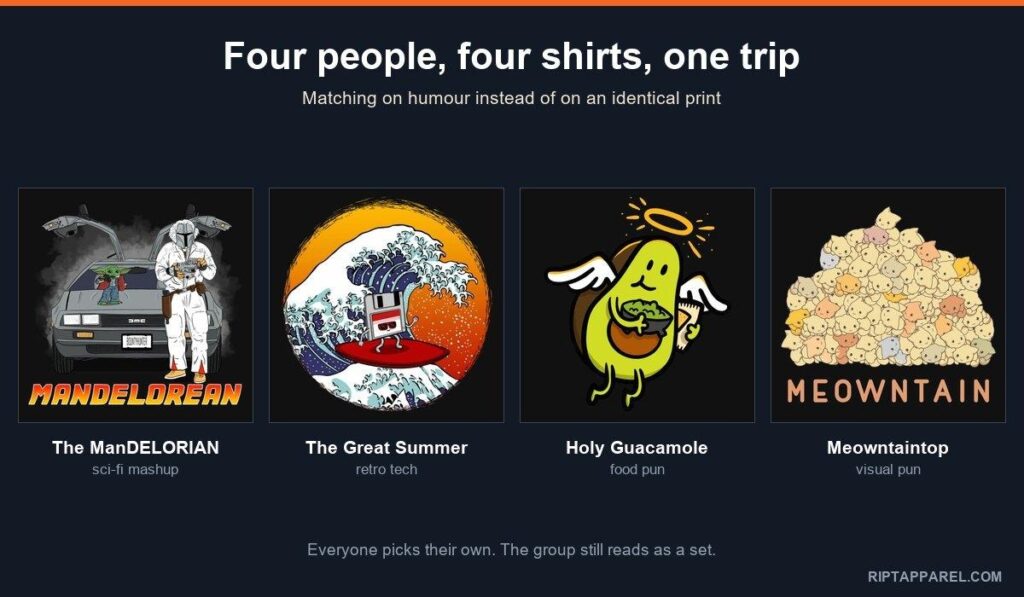
Four people, four different shirts, one trip. Matching on humour rather than on an identical print is what stops the shirts being abandoned by day three.
| If your family shares… | The approach | Where to look |
|---|---|---|
| A galaxy far, far away | One design each, all from the same saga | Star Wars graphic tees |
| Cartoons across a wide age range | The safest common ground when ages run from six to sixty | Cartoon graphic tees |
| Anime | Different series each, or one series across the group | Anime graphic tees |
| A sense of humour and nothing else | Puns and visual jokes travel across every age in the group | Funny graphic tees |
| Nothing in particular | Go by season instead of fandom, and match on colour | Summer designs |
Matching by theme rather than by identical print. Each person still chooses.
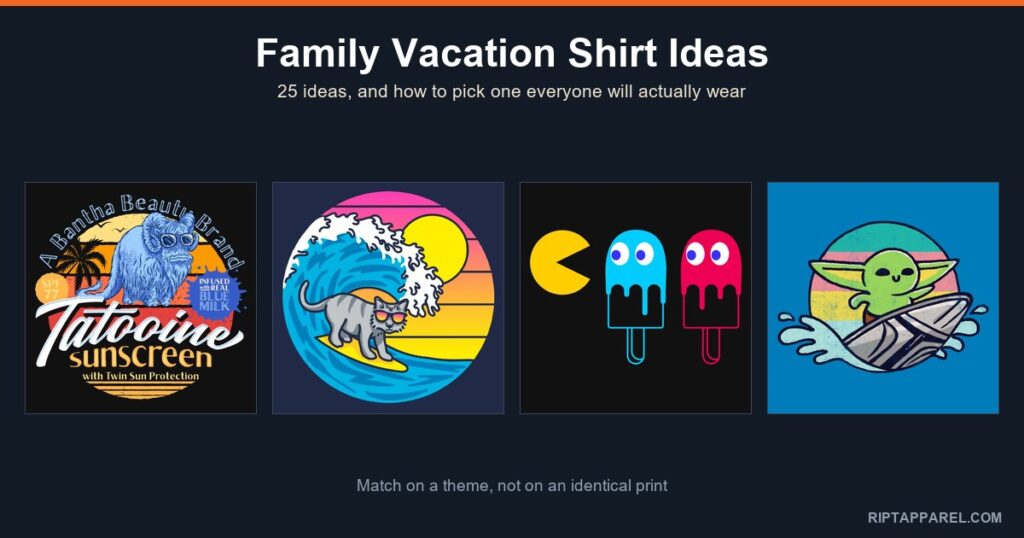
A few of these work particularly well for travel in a way that is worth spelling out. The Tatooine Sunscreen tee is a mock beach-brand label set on a desert planet, complete with SPF 77, which is a better vacation joke than most printed slogans. The ManDELORIAN pairs a masked gunslinger with a gullwing car for the two-fandom households.

For a beach week, Pack for Summer puts a retro arcade maze-muncher on melting popsicles. The Great Summer sends a lone floppy disk riding a towering wave. Both read as summer without the palm-tree cliche.
Everything sits in the same size range, so a family can order across the full catalogue in one go. New designs land daily on the daily deals page , which is worth checking in the weeks before a trip.
| Before you order, either way, Confirm every size in writing. Guessing is the single most common failure. Buy one spare in the most common size. Pick a darker colour if the trip involves full days outdoors.Check the shipping and returns policy against your departure date, not today’s date.Order six weeks out for custom, or two weeks out for ready-made. |
The strongest option is a shared format with a personal line for each person. A “most likely to” roster does this well, because everyone gets their own prediction while the layout stays identical. Destination and year is the safe default if you want something nobody will argue about. An inside joke that means nothing to anyone outside the family beats both of them.
Order six weeks before travel if you are going custom, because that covers proofing, one revision, production and shipping, with a buffer for one problem along the way. Ready-made shirts need only standard delivery, so two weeks is usually comfortable.
For photographs, and for keeping track of children in crowds, they genuinely are. The complaint is almost always about identical shirts rather than about matching itself. Match on colour or theme, give each person their own variation, and the objection largely disappears.
A mid to dark shade in a colour nobody in the group hates. Dark and bright colours absorb ultraviolet rather than letting it through, so they offer better sun cover than white or pastels. Darker shades also hide sunscreen marks and spills far better across a long day out.
Far less than most people assume. A white cotton t-shirt is roughly UPF 5 to 7, dropping to about UPF 3 once it is wet. Clothing needs a UPF of 50 to carry the Skin Cancer Foundation’s Seal of Recommendation. Treat a printed cotton tee as clothing rather than as sun protection.
Screen printing for larger groups and simple one or two colour designs, because a cured screen print is the most hard-wearing. Direct-to-garment for small families and detailed multi-colour artwork, since there is no setup cost to spread. Vinyl is best kept for names and numbers on the back.
The price depends far more on quantity than on the design itself. Setup costs are spread across the whole order, so a group of twenty pays much less per shirt than a group of four does. Small families usually find ready-made designs cheaper per person.
The ship name with the sail year, nautical stripes with no print, an embarkation-day joke, or cabin numbers on the back. The ship already supplies the context, so the shirt can be quieter than it would need to be on land.
Give them a choice inside the theme rather than handing over a finished shirt. Let them pick their own design from a shared fandom, or write their own line on the roster. Agreeing a single photo day, rather than the whole week, also works well.
Yes, and it is very often the better answer anyway. One shared colour across everyone’s own shirts photographs nearly as well as identical prints do. Matching caps or wristbands work for groups who will not wear a matching shirt at all.