
Key takeaways
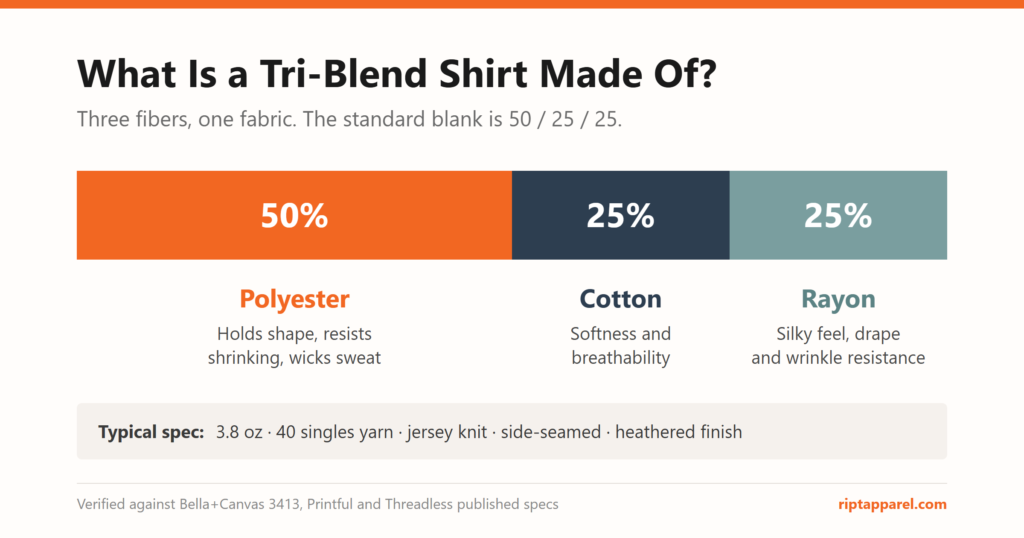
A tri-blend shirt is made from three fibers: polyester, cotton, and rayon. The most common mix is 50% polyester, 25% cotton, and 25% rayon. That blend makes the shirt very soft, light, and slightly stretchy. It shrinks less than a 100% cotton tee, and it has a faded, speckled look that the industry calls heathered.
You will also see it written as tri blend, triblend, or tri-blend t-shirt. Those all mean the same fabric.
A tri-blend uses three fibers instead of one. Each fiber does a different job.
| Fiber | Typical share | What it adds |
|---|---|---|
| Polyester | 50% | Holds shape, resists shrinking, wicks sweat |
| Cotton | 25% | Softness, breathability, natural feel |
| Rayon | 25% | Silky feel, drape, extra breathability |
Most tri-blend tees weigh between 3.0 and 4.1 ounces. A standard cotton tee usually weighs 4 to 6 ounces. So a tri-blend is noticeably lighter in your hand.
The yarn is finer too. Many tri-blends use 40 singles yarn. “Singles” is just a count of how fine the yarn is, and a higher number means a thinner, smoother thread. A basic cotton tee often uses 30 singles. That finer yarn is a big part of why a tri-blend feels soft.
Most tri-blends are also knit as a jersey, which is the same stretchy knit used for sports shirts, and sewn with side seams so the shirt follows your body instead of hanging straight down.
Search for this and you will find two answers. Some pages say 50% cotton, 25% polyester, 25% rayon. Others say 50% polyester, 25% cotton, 25% rayon. They cannot both be right.
The blank shirts that almost every printer actually uses are polyester-first. Bella+Canvas lists its 3413 tri-blend as 50% polyester, 25% combed and ring-spun cotton, 25% rayon at 3.8 oz and 40 singles. Printful and Threadless both publish the same 50/25/25 polyester-first split for their tri-blends.
So treat 50% polyester, 25% cotton, 25% rayon as the standard. A few brands do shift the mix, and one common alternative runs 50% polyester, 38% cotton, 12% rayon. The tag on the shirt is always the final word.
Polyester is a synthetic fiber. It is strong and it holds its shape well. It does not soak up much water, so it moves sweat away from your skin and dries fast. That property is called moisture-wicking. Polyester is also the main reason a tri-blend barely shrinks, and it is what gives the shirt a little stretch and bounce-back.
Cotton is a natural fiber that grows on a plant. It is soft and it breathes well. In a tri-blend, the cotton is usually combed and ring-spun. Combing removes the short, rough fibers. Ring-spinning twists what is left into a smooth yarn. The result feels softer than plain cotton and pills less.
Rayon is a semi-synthetic fiber, sometimes sold as viscose. It is made from wood pulp that gets broken down and spun into thread. Rayon gives a tri-blend its silky feel and its drape. Drape is how the fabric hangs and moves on your body. Rayon also helps the shirt resist wrinkles.
Rayon has one weak spot. It gets weaker when it is wet. That is why tri-blends need a gentle wash.
Soft, light, and a little stretchy.
Most people say a tri-blend feels like a shirt they have already owned and washed a hundred times, straight out of the package. It hangs closer to the body than a stiff cotton tee, so it reads as a fitted or fashion cut even when the size is the same.
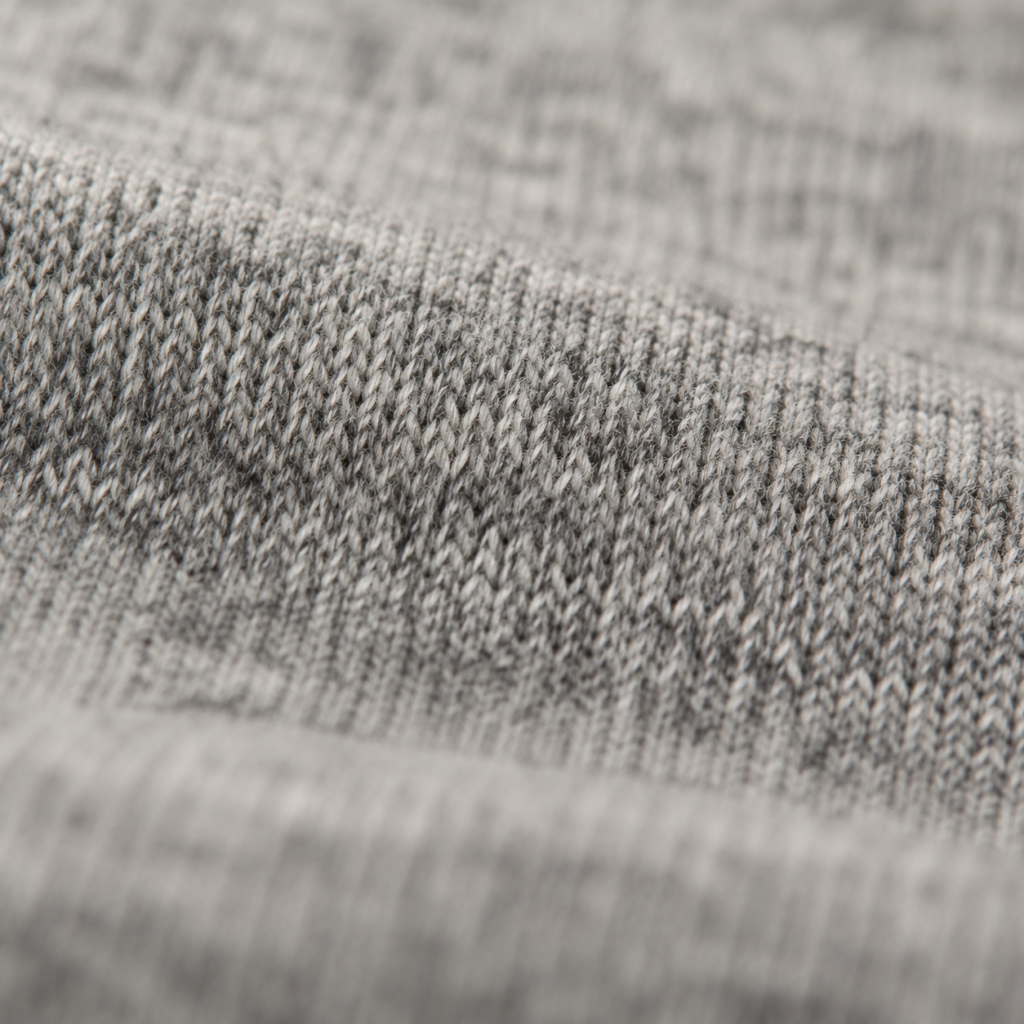
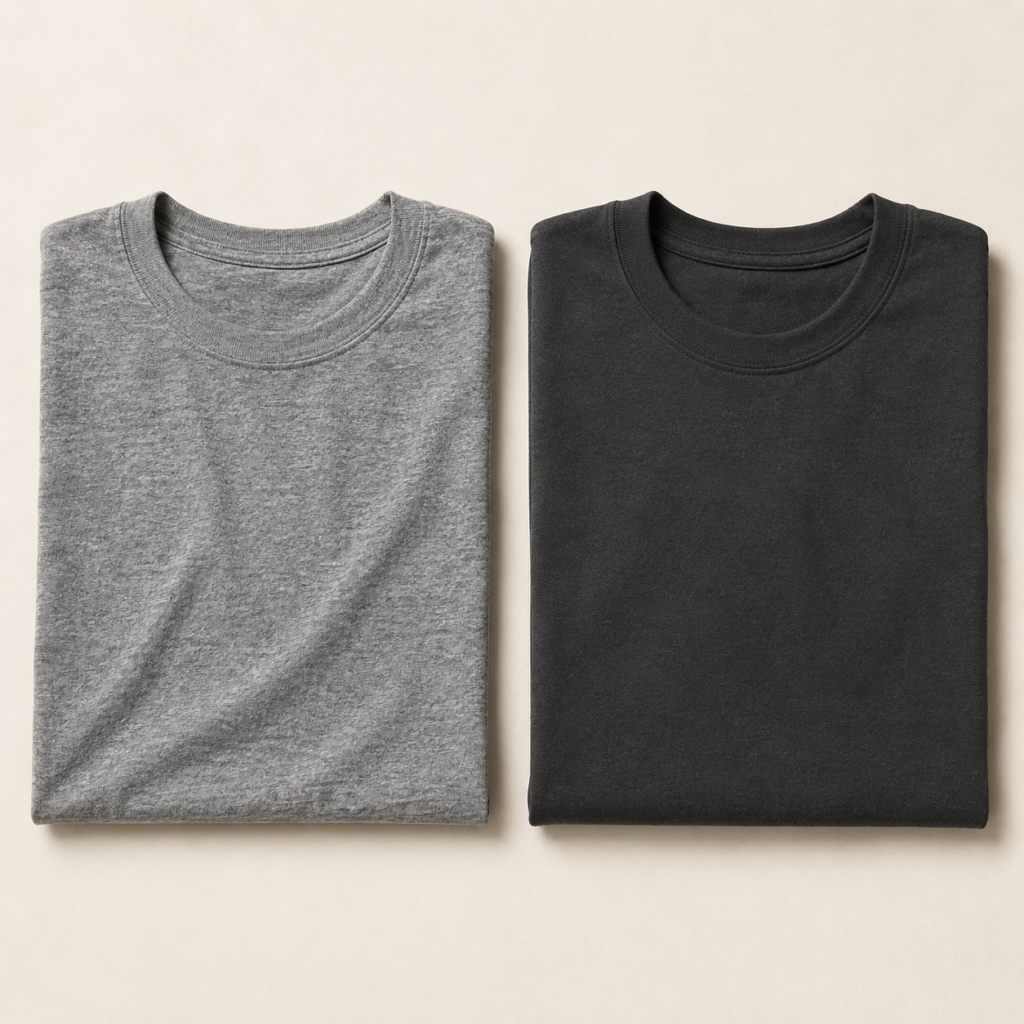
The color looks different too. The three fibers soak up dye at different rates. Polyester barely takes dye, cotton takes a lot, and rayon lands somewhere in between. That is what creates the speckled, dappled look called heather. A flat, solid color is very hard to get on this fabric.
Five quick checks:
If the tag lists only cotton and polyester, it is a 50/50 or a CVC, not a tri-blend. The missing fiber is rayon.
These four fabrics cover almost every T-shirt you will ever buy. CVC stands for “chief value cotton,” which just means a blend with more cotton than polyester.
| Tri-blend | 100% cotton | 50/50 | CVC | |
|---|---|---|---|---|
| Fibers | Poly, cotton, rayon | Cotton | Cotton, poly | Mostly cotton, some poly |
| Feel | Softest, silky | Soft, sturdy | Middle ground | Soft, cotton-like |
| Weight | 3.0 to 4.1 oz | 4 to 6 oz | 4 to 5 oz | 4 to 5 oz |
| Shrinking | Very little | Shrinks most | Very little | A little |
| Stretch | Slight stretch | Little to none | Slight stretch | Slight stretch |
| Breathability | Good, wicks sweat | Best, holds sweat | Good | Good |
| Print look | Softer, faded | Brightest, sharpest | Fairly bright | Bright |
| Color | Heathered | Solid and even | Slightly heathered | Near solid |
| Wrinkles | Resists them | Wrinkles most | Resists them | Resists a little |
| Price | Highest | Lowest | Low | Middle |
Short version: pick a tri-blend if you want the softest, lightest shirt. Pick 100% cotton if you want a sturdier shirt and a bolder print. Pick 50/50 or CVC if you want some of both for less money.
If you are still deciding, our guide on how to choose a graphic tee covers fit and print quality too.
Yes, a little more than a basic cotton tee. The polyester lets the fabric give when you move and then pull back to its original shape. It is not a workout-level stretch, but you notice it.
Less than cotton. Both the polyester and the rayon help the fabric resist creasing, so a tri-blend usually comes out of a bag looking fine. A 100% cotton tee wrinkles the most of any common shirt fabric.
Yes. It is one of the better warm-weather tees. It is light, it breathes, and the polyester pulls sweat off your skin so the shirt does not cling. The loose drape also lets air move.
Usually not, but they are thinner than a cotton tee. A good tri-blend jersey is knit to stay opaque even at 3.8 oz. Light colors like white, ash, and pale grey show the most, so hold one up to a light if that matters to you.
They can. Pilling is the little balls of fiber that form on a shirt after a lot of wear. Polyester is the fiber most likely to pill, and a tri-blend is half polyester. Washing cold and skipping the dryer slows it down a lot.
Barely. Polyester makes up half the fabric, and polyester does not shrink much. A tri-blend usually keeps its size and shape through many washes. A 100% cotton tee is far more likely to shrink, especially in hot water or a hot dryer.
Two reasons, and one of them surprises people.
The first is texture. The fabric is thin and heathered, so screen printing ink cannot sit perfectly flat on it. The ink sinks in a little and the speckled fibers show through the design. That gives you a soft, slightly washed-out look. It is the main reason vintage-style tees are so often tri-blends.
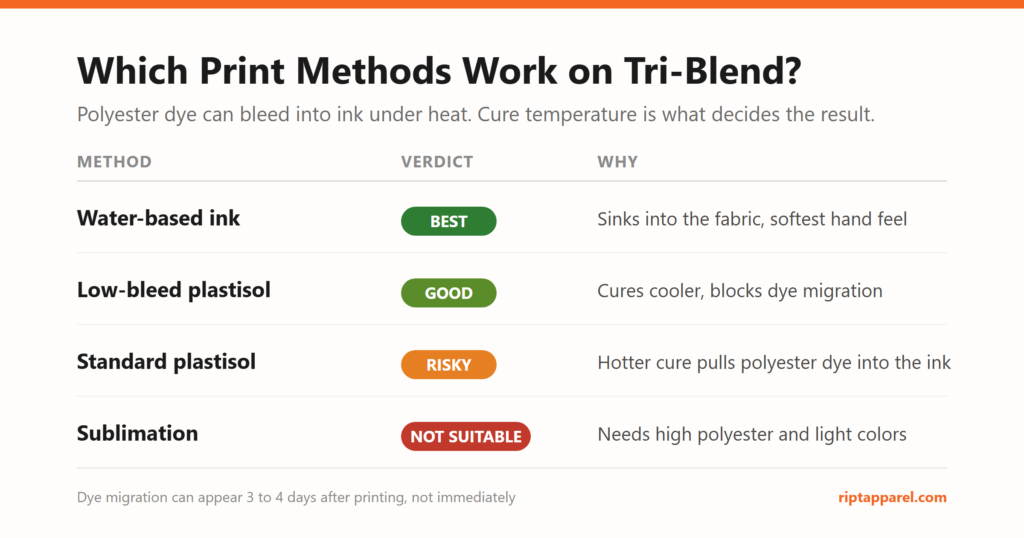
The second is dye migration. Polyester dye can lift out of the fabric under heat and bleed up into the ink. A white print on a red tri-blend can turn pink days after it was made. Printers work around it with low-bleed inks that cure at lower temperatures, or with water-based inks for the softest finish.
This is why print method matters more on a tri-blend than on cotton.
| Print method | On tri-blend | Why |
|---|---|---|
| Water-based ink | Best | Sinks into the fabric, softest hand feel |
| Low-bleed plastisol | Good | Cures cooler, blocks dye migration |
| Standard plastisol | Risky | Higher cure temp can pull polyester dye into the ink |
| Sublimation | Not suitable | Needs high polyester content and light colors |
If you want a bright, sharp graphic with solid colors, 100% cotton prints better. Detailed artwork can look muddy on a tri-blend.
Tri-blends are the most expensive blank shirts on the market. Whether the extra cost makes sense depends on what you want.
A tri-blend is worth it if:
A tri-blend is not worth it if:
Rayon gets weaker when wet, so treat a tri-blend gently.
These steps work on almost any printed tee, not just tri-blends.
People ask us this, so here is the straight answer: RIPT tees are not tri-blends.
| Item | Fabric |
|---|---|
| Men’s and women’s (juniors) tees | 100% combed ring-spun cotton by Tultex |
| Youth tees | 100% cotton Gildan Ultra Cotton |
| Hoodies | Bella+Canvas pullover hoodies |
We also sell Premium versions of the men’s and women’s tees, which use a cotton and polyester blend. That is a two-fiber blend, not a tri-blend. The fiber a tri-blend adds is rayon, and we do not use it.
We print on combed ring-spun cotton on purpose. Our designs are detailed pop culture artwork with fine line work and solid colors, and cotton holds a sharper, brighter print than a heathered tri-blend does. Cotton also sidesteps the dye migration problem entirely. Combed ring-spun cotton still stays soft, because the rough fibers are removed before the yarn is spun.
Our shirts are labeled preshrunk. They can still shrink in a hot dryer, so wash them inside out and hang them to dry. Full care and sizing details are on the RIPT FAQ page.
Every design below is printed on combed ring-spun cotton. A new one drops every day.
| Design | Fandom |
|---|---|
| Hello Darkness My Old Friend | Star Wars |
| Neo Vespa | Anime |
| Nice Try | Horror |
| Yelling Bat At Cat | Batman |
| Karate Fighter | Video games |
| A Cup Of Stupiditea | Funny |
| Last Century Retro Club | Retro |
| I’m With You | Marvel |
Browse by fandom: Star Wars tees, horror tees, funny tees, and retro tees.
Or see today’s daily drop and the full shop.
| If you want… | Buy this |
|---|---|
| The softest, lightest shirt | Tri-blend |
| A bright, sharp graphic | 100% cotton |
| A shirt that will not shrink | Tri-blend or 50/50 |
| A thicker, sturdier shirt | 100% cotton |
| A vintage, faded print look | Tri-blend |
| The lowest price | 100% cotton |
| Something in the middle | CVC or 50/50 |
There is no single best fabric. There is only the fabric that fits what you want the shirt to do.
If you are new to this, our explainer on what graphic tees are is a good next read. And if you are wondering whether they are still worth wearing, we looked at that in are graphic tees still in style.
Fabric pages contradict each other constantly, so we worked from published garment specs rather than repeating what other blogs say. The 50/25/25 polyester-first ratio, the 3.8 oz weight, and the 40 singles yarn count come from Bella+Canvas 3413 specs, cross-checked against the tri-blend specs published by Printful and Threadless. The RIPT fabric details come from our own FAQ page.
A tri-blend shirt is made from three fibers: polyester, cotton, and rayon. The usual mix is 50% polyester, 25% cotton, and 25% rayon. It is softer, lighter, and stretchier than a 100% cotton tee, and it shrinks less.
Polyester, cotton, and rayon. Polyester holds the shape and resists shrinking. Cotton adds softness and breathability. Rayon adds a silky feel and drape.
Most t-shirts are 100% cotton, a 50/50 cotton and polyester blend, a CVC blend, 100% polyester, or a tri-blend of polyester, cotton, and rayon. Cotton is the most common.
Neither is better overall. Tri-blend is softer, lighter, and shrinks less. Cotton is sturdier, cheaper, and holds a brighter, sharper print.
Very little. Half the fabric is polyester, and polyester barely shrinks. A tri-blend holds its size much better than a 100% cotton tee.
Yes, slightly more than a basic cotton tee. The polyester lets the fabric give when you move and then return to its shape.
Less than cotton. The polyester and rayon both help it resist creasing. A 100% cotton tee wrinkles the most.
Yes. It is light, it breathes, and the polyester wicks sweat away so the shirt does not cling in heat.
Usually not, but they are thinner than cotton tees. A good tri-blend jersey stays opaque. Light colors show the most.
They can, because polyester is the fiber most likely to pill and a tri-blend is half polyester. Washing cold and air drying slows it down.
The fabric is thin and heathered, so ink does not sit flat on it. Polyester dye can also migrate into the ink under heat. Both soften the print.
No. A 50/50 has two fibers, cotton and polyester. A tri-blend adds a third fiber, rayon, which is what gives it the silky drape.
CVC means chief value cotton, a two-fiber blend with more cotton than polyester. It feels close to cotton and prints brighter. A tri-blend has rayon, drapes more, and costs more.
Turn it inside out, wash in cold water on a gentle cycle, skip the bleach and fabric softener, and hang dry or tumble dry on low. Rayon weakens when wet, so avoid heat.
No. RIPT men’s and women’s tees are 100% combed ring-spun cotton by Tultex. Youth tees are Gildan Ultra Cotton, and hoodies are Bella+Canvas. We use cotton because it holds a sharper print for detailed artwork.