
In May 2025, the platform we hosted our website on for 9 years unexpectedly took us down. To learn the full story of our journey, our challenges, and our comeback, visit our new page: RIPT Revival
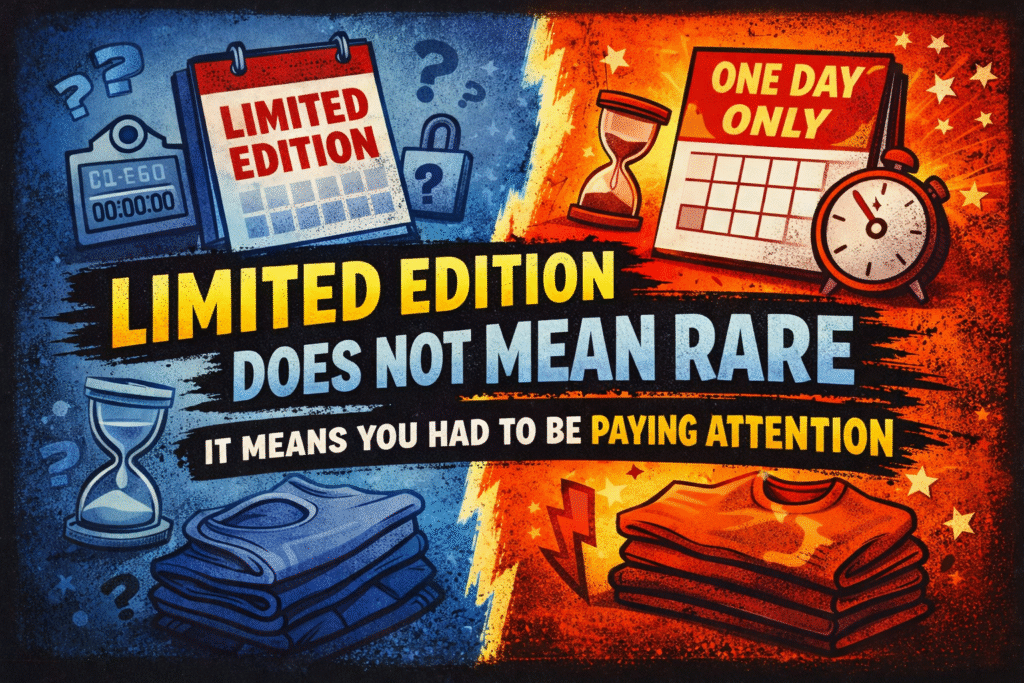
Limited edition has become one of the most overused phrases in online retail. Everything is limited. Everything is exclusive. Everything somehow still available six months later.
https://riptapparel.com/daily-graphic-t-shirts/
https://riptapparel.com/pages/best-sellers
https://riptapparel.com/fight-like-a-woman-exclusive/
Real fans notice this immediately.
Scarcity only works when it reflects attention, not inventory manipulation. Something feels limited when it existed briefly and then moved on, not when it was artificially restricted and endlessly teased.
This is why daily pop culture designs resonate differently. They are not limited because someone decided to cap the quantity. They are limited because time passed.
If you were paying attention that day, you saw it. If you were not, you missed it. That is it.
This idea connects directly back to why daily pop culture t-shirts still matter to real fans. The value comes from awareness, not ownership. Wearing one later is simply a byproduct of having been present when it mattered.
Static catalogs try to manufacture scarcity with labels and countdowns. Daily drops do not need to. Tomorrow’s design naturally replaces today’s. Attention moves forward whether a brand wants it to or not.
Fans understand this intuitively because it mirrors how culture works everywhere else. A moment happens. People react. Then the conversation shifts. The fact that something is no longer available does not make it more valuable. The fact that it happened at all does.
This is also why daily drops vs static catalogs and why fans get bored faster than brands expect is not really about design volume. It is about rhythm. One idea per day forces clarity. It forces intention. It forces both creators and fans to let go.
RIPT treats limited edition as a side effect, not a feature. Designs go live as part of a daily cycle and then step aside for whatever comes next. That structure rewards people who check in regularly without punishing those who do not.
The result is a different relationship with scarcity.
There is no pressure to chase. No fear of missing out manufactured through urgency. You either caught the design or you did not. Both outcomes are normal. The point is not accumulation. The point is participation.
That is why checking the Daily Deals never feels like scrolling a clearance page. It feels like catching a moment in passing. Sometimes you stop. Sometimes you keep walking.
For fans who are tuned in to their interests, that kind of scarcity feels honest. It respects attention instead of exploiting it.
And in a culture that constantly demands more focus, that distinction matters.
Related Reading:
https://riptapparel.com/best-graphic-t-shirt-sites-for-pop-culture-fans/
https://riptapparel.com/limited-edition-graphic-tees/
https://riptapparel.com/ript-vs-onceuponatee/