
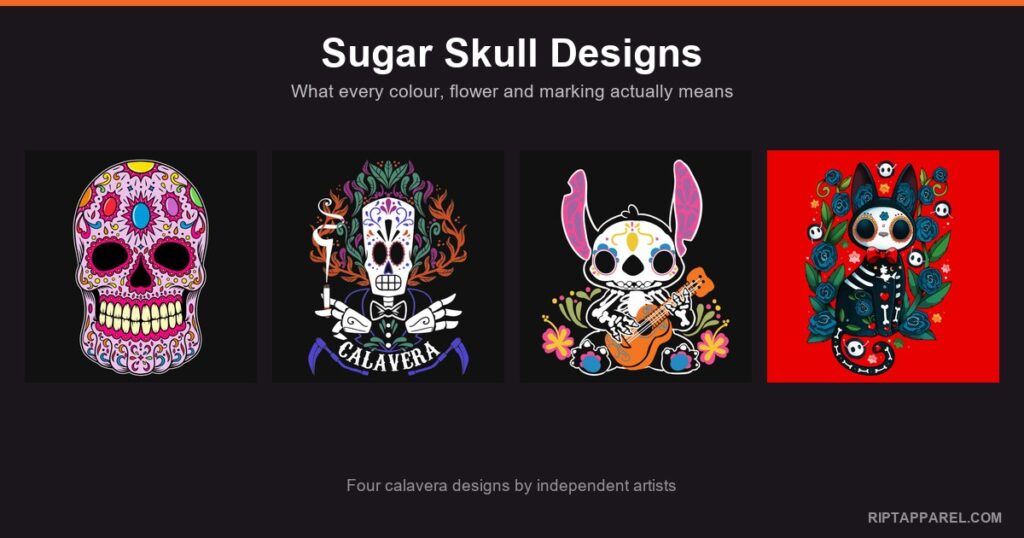
The short version
| Sugar skull designs are decorated skulls made for Día de Muertos, the Mexican Day of the Dead. Each part means something. The name on the forehead names the person. The flowers guide their spirit home. The bright colours and the smile are there because the day is a welcome, not a scare. |
Most sugar skull designs you find online arrive with no explanation attached, so you get the picture without ever getting the meaning behind it.
That is a real shame, because almost every part of a sugar skull stands for something specific. The smile, the flowers and the name written across the forehead are all deliberate, and none of it is decoration for its own sake.
This guide covers what each part means, where the designs came from, and how artists are still playing with them nearly three hundred years later.
A sugar skull is a brightly decorated skull made for the Day of the Dead, and the Spanish word for it is calavera , which simply means skull.
That word choice matters more than you might expect. In English “skull” sounds dark and a little threatening, but calavera carries none of that weight in Spanish. It is an ordinary word, and on this particular holiday it is a warm one.
The first sugar skulls were made from a sugar paste called alfeñique , which you make by heating sugar and water together. The paste gets pressed into a mould and left to set hard, then decorated with brightly coloured icing.
They are called sugar skulls for the least mysterious reason possible: they are made of sugar.
| A surprise: sugar skulls are not only for the dead. People make them for living friends and family too, with that person’s name on the front. Getting one is a compliment, not a threat. |
The short answer is that two very different cultures met, and something new came out of the collision.
Long before Europeans arrived, people across Mexico placed real skulls on altars to honour their dead, and skulls were an ordinary part of religious life rather than a shocking one.
Then the Spanish arrived, and over time the real bones were replaced with sugar ones.
The sugar craft itself had already travelled a remarkable distance to get there. It reached Spain during the Arab rule of the Iberian Peninsula, which lasted from roughly the year 700 until the late 1400s, and from Spain it crossed the Atlantic to Mexico.
The first written record of skeleton sweets being sold dates to the 1740s , and back then they were made mainly as treats for children rather than as altar decorations.
One thing is worth knowing before you go further: the cheerful tone is modern. There is no evidence that the older Aztec practice carried the playfulness the holiday has today, and that lightness arrived much later.
The 1st and 2nd of November , with preparations beginning in late October, and UNESCO added the holiday to its list of Intangible Cultural Heritage in 2008 under the name “Indigenous festivity dedicated to the dead” after first proclaiming it five years earlier in 2003.
UNESCO describes families laying “flower petals, candles and offerings along the path leading from the cemetery to their homes.” The idea is to help the dead find their way back for one night.
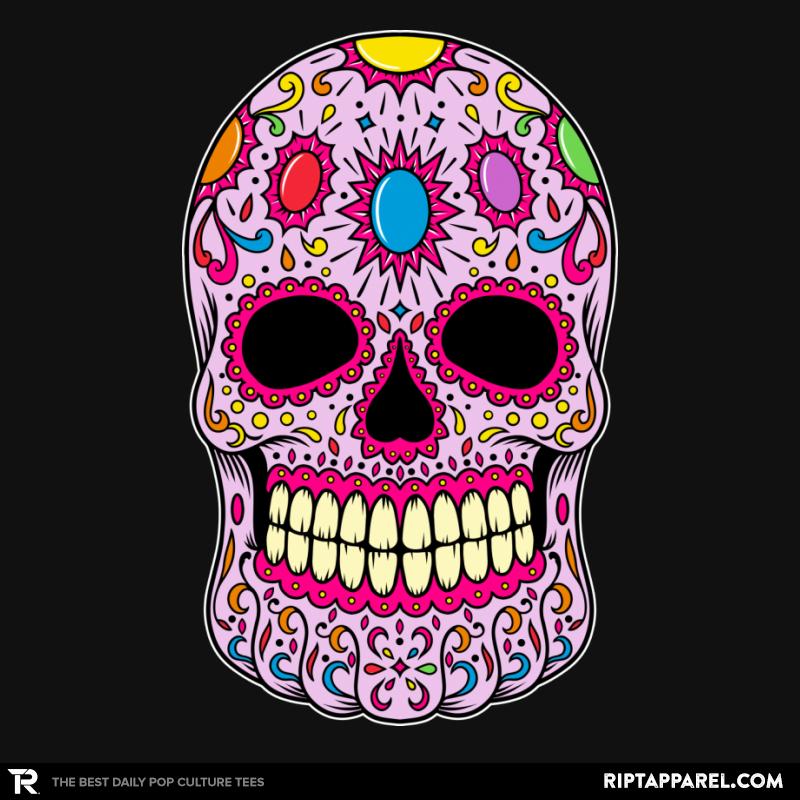
This is the part almost every other guide skips entirely, so here is what you are actually looking at when you see one.
A sugar skull is never a generic skull, because it stands for one specific person whose name is written across the forehead.
That single detail changes how you read everything else on it, since what you are looking at is closer to a portrait than a decoration.
Sugar skulls smile because the whole day is built as a welcome, and families believe the dead come back to visit for one night. You would not greet a returning guest with a frightening face.
That cheerfulness is the single biggest difference between a calavera and a Halloween skull, and it is worth sitting with for a moment before you read on.
Eyes are rarely left plain on a finished skull, and two of the most common choices carry their own meaning:
Almost every sugar skull carries flowers, and it is nearly always the same flower, for reasons worth explaining properly further down this page.
The swirls, dots, webs and patterns are not filler, because the effort itself is the offering. A plain skull would say very little, while a carefully decorated one says that somebody spent real time thinking about you.
Colour does an enormous amount of work on a sugar skull, and these are the meanings that come up most often across the sources we checked.
| Colour | What it commonly stands for |
|---|---|
| Red | Blood and life |
| Orange | The sun |
| Yellow | The marigold, and death itself |
| Purple | Grief and mourning |
| Pink | Joy and celebration |
| White | Purity and hope |
| Black | The land of the dead |
Widely shared meanings, not a fixed code. Families and regions differ.
Because the marigold has been the flower of the dead in Mexico for a very long time, and the connection runs deeper than decoration.
Its Spanish name is cempasúchil , which comes from Nahuatl, the Aztec language. The original word was cempohualxochitl , built from cempohualli meaning twenty and xochitl meaning flower, so the name translates roughly as twenty flowers.
Twenty was never a random number to choose, because Aztec counting was built in twenties the way ours is built in tens, which made twenty a way of saying complete .
There is an older Nahuatl name for it as well, miccáxochitl , which translates directly as flower of the dead and was in use long before the Spanish ever arrived.
The plant itself is Tagetes erecta , native to Mexico and Central America, and it is both startlingly orange and very strongly scented.
That combination is exactly the point, because the colour and the smell together are believed to guide spirits home . Families lay the petals in a path running from the cemetery all the way to the front door.
Sugar skulls sit on an ofrenda , which is an offering table, and a full one is built across three levels and deliberately covers all four elements:
| Element | How it appears |
|---|---|
| Fire | Candles |
| Air | Papel picado , cut paper that moves in a draught |
| Earth | Food, including the sweet bread pan de muerto |
| Water | A glass of water, for the thirst of the journey |
There is usually copal incense burning alongside all of it, together with photographs of the people the family is remembering that year.
People mix these two up constantly, and the fact that the dates fall within days of each other only makes the confusion worse.
| Sugar skull (calavera) | Halloween skull | |
|---|---|---|
| Purpose | Honour one named person | Frighten |
| Mood | Happy, often funny | Dark |
| Colours | Bright, many colours | Usually black and white |
| Where it goes | On an altar or a grave | On a costume or a porch |
| The word | Calavera sounds neutral in Spanish | “Skull” sounds grim in English |
One of them is a portrait of somebody who was loved, and the other exists to give you a fright, which is the whole difference in a single line.
If you have ever seen a skeleton wearing an enormous feathered hat, then you have already met La Catrina, who is comfortably the most copied sugar skull image in the world.
Here is the part that almost nobody mentions when they print her on things: she began her life as a joke about rich people.
A printmaker called José Guadalupe Posada (1852–1913) etched her somewhere around 1910 to 1912, and she was first published in 1913 as part of a satirical broadside.
His target was wealthy Mexican women of the time who copied European fashion and looked down on their own culture. The Spanish word catrin means a dandy someone over-dressed and pleased about it. The joke is that underneath the hat, she is a skeleton like everybody else.
Posada himself never gave her a name at all, and the title La Calavera Catrina only became attached to the image by 1930, when it appeared in a book.
Then Diego Rivera painted her into a mural in 1946–47, Sueño de una Tarde Dominical en la Alameda Central . It runs about 15.6 metres. That mural is where most of the world met her, and she has been a Mexican icon ever since.
| A class joke from before the Mexican Revolution is now printed on millions of shirts, mugs and tattoos. Posada would probably have found that very funny. |
Day of the Dead is not only a visual tradition, because it comes with a writing tradition attached that most people outside Mexico never hear about.
They are called calaveras literarias , or literary skulls, and they are short comic poems that describe a living person as though they had already died. You write one about your boss, your closest friend, or a politician you cannot stand.
The tone is teasing rather than cruel, and the point underneath the joke is that death is coming for every one of us, so we may as well laugh about it together.
A newspaper called El Calavera started printing them in 1847 and was shut down quickly. By the end of that century the poems were everywhere, illustrated with skeleton drawings that mocked powerful people. That is the world Posada was working in.
A living tradition keeps absorbing new material, and sugar skull designs have taken in comic books, cartoons and video games without any of that being new or disrespectful in itself.
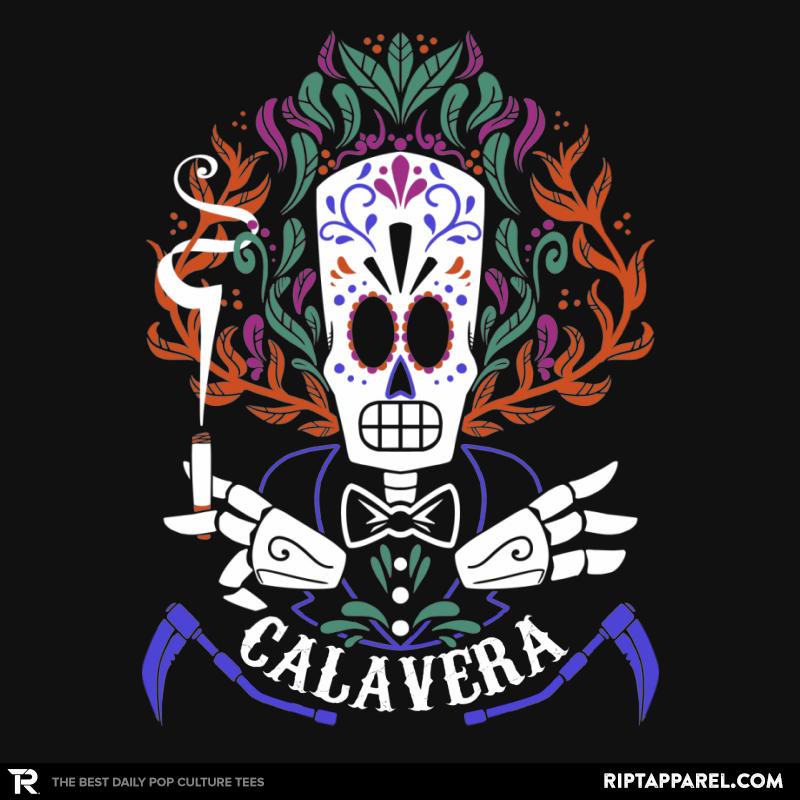
Grim Fandango arrived in 1998 from LucasArts, directed by Tim Schafer, and the entire game is built out of calavera art with every single character rendered as a skeleton.
It also draws on a genuine belief rather than just the look, because Aztec tradition holds that the soul takes a four-year journey after death, and Schafer built the game around exactly that journey.
So this is not some recent trend borrowed from social media, given that a major game studio was doing it seriously nearly thirty years ago.
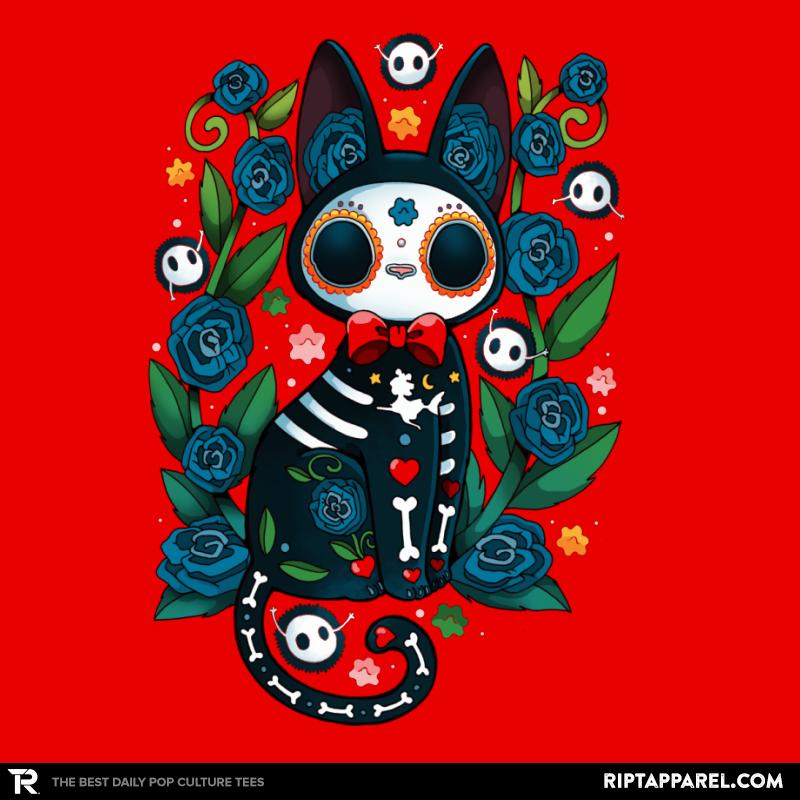
RIPT works with thousands of independent artists and calavera designs come through our daily drop regularly, with four available right now:
| Design | What it plays with |
|---|---|
| Calavera | Grim Fandango: the game above |
| Calavera Alien | Lilo & Stitch, from our cartoon tees |
| Infinity Calavera | Marvel, from our Marvel tees |
| Calavera Witched Cat | Cats and witches |
All four are in stock. See them together in the Mexico collection.
There is a line here worth naming plainly, because turning a calavera into a horror monster misses the point completely. That is what horror tees are for, and they are a genuinely different thing. The whole tradition exists to make death feel gentle, so adding gore to it undoes the one job it was built to do.
People ask this question constantly, so here is a straight answer rather than a careful dodge.
Usually yes, provided you know what you are wearing. Día de Muertos is not a closed tradition, and Mexican writers on the subject mostly welcome outsiders taking part in it.
What they ask for is simple:
Here is the short test worth applying: are you wearing it because you think it looks brilliant and you know what it means, or because you think skulls are generically spooky? The first is completely fine, and the second is where people go wrong.
One person each. The skull stands for death, the sugar stands for the sweetness of life, and the name on the forehead ties it to somebody real. Together they say: this person died, and we still love them.
Some, not all. Skulls made from alfeñique sugar paste are usually decorations. Edible ones are often made from chocolate or amaranth instead, and are wrapped for sale. If you are given one, ask.
Because the skull stands for that person. It can be someone who has died, or a living friend. Sugar skulls are given as gifts to the living too, which surprises most people.
Purpose. A sugar skull honours a named person and is meant to look happy. A Halloween skull is meant to scare. They are different holidays with different points.
No. Halloween is 31 October. Día de Muertos is 1 and 2 November. Halloween plays with fear. Día de Muertos is about welcoming people back.
They guide the dead home. The bright orange and the strong smell are believed to lead spirits to the altar. Families lay the petals in a path from the cemetery to the house.
Skull, in Spanish. It does not sound dark the way “skull” does in English. It is also used for the decorated skulls and for the joke poems.
A skeleton in a big feathered hat, drawn by José Guadalupe Posada around 1910–12 and published in 1913. She began as a joke about rich Mexicans copying European fashion, and became a national symbol after Diego Rivera painted her in 1946–47.
Red is blood and life. Orange is the sun. Yellow is the marigold and death. Purple is grief. Pink is joy. White is purity. Black is the land of the dead. These vary by region and family.
Usually not, if you know what it means and treat it with respect. The clearest thing to avoid is adding blood or horror to it. Supporting Mexican and Indigenous artists is the best way to take part.
1 and 2 November, with preparations through late October. UNESCO added it to its heritage list in 2008.
Because the day is a celebration. The colours match the marigolds and the rest of the altar. A dull skull would be the wrong note entirely.