
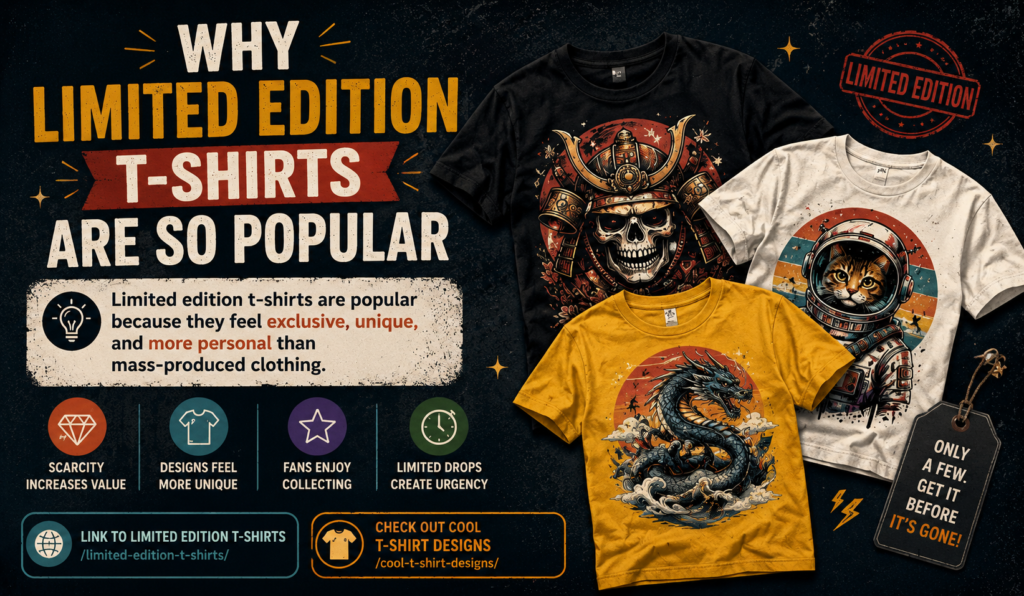
Limited-edition t-shirts are popular because scarcity makes ownership feel meaningful. When a design is only available for 24 hours or a few hundred units, wearing one becomes a signal—you were paying attention, you cared enough to act, and you have something most people can’t get anymore.
Marketers have known for decades that scarcity drives action. But limited-edition apparel works differently from most scarcity plays. It’s not artificial pressure to convert a one-time buyer. It’s a structural promise: this design will not be here forever, and if you want it, you need to be paying attention now.
That structure changes the relationship between fan and brand. You stop browsing and start watching. You learn the drop schedule. You check the site like you check a feed—not because you’re being marketed to, but because you don’t want to miss something good.
Pop culture fans are uniquely tuned for this. They already track release schedules, follow creators, and collect signals. A limited-edition t-shirt fits that mental model perfectly. It rewards the same behavior fans use for new comics, album drops, and game releases.
Browse the 3,415 customer reviews on our site and you’ll see this pattern over and over: “got this on the drop day,” “almost missed it,” “glad I checked.” It’s not just clothing. It’s a small act of fandom attentiveness.
Almost every brand uses the word “limited” now. Most of them shouldn’t. If a “limited-edition” hoodie is still in stock six months later, the word doesn’t mean anything—it’s marketing copy, not a structural constraint.
Real limited editions have an end. They sell out. They’re not re-stocked. The artist moves on to the next design. That’s the model behind our daily drops—the design that’s live today won’t be live tomorrow.
The limited-edition model isn’t just about consumer psychology. It also gives independent designers a platform that mass-marketplaces can’t. An artist’s design gets the spotlight for a full day, with curated context, rather than fighting for visibility in a 50,000-design feed. That changes both the economics and the experience.
Are limited-edition t-shirts more expensive?
Not significantly. Most limited drops sit in the same $15-$25 range as standard graphic tees. The value isn’t in the price; it’s in the design exclusivity.
Can I get a sold-out design later?
Sometimes. Best-selling designs occasionally return as “anytime” tees. The best sellers page is the best place to find revived favorites.
How do I keep up with drops?
Subscribe to drop alerts, follow the brand on social, or just bookmark the daily-drop page and check in.
Browse our latest: Today’s drop · Best sellers · 3,415 customer reviews