
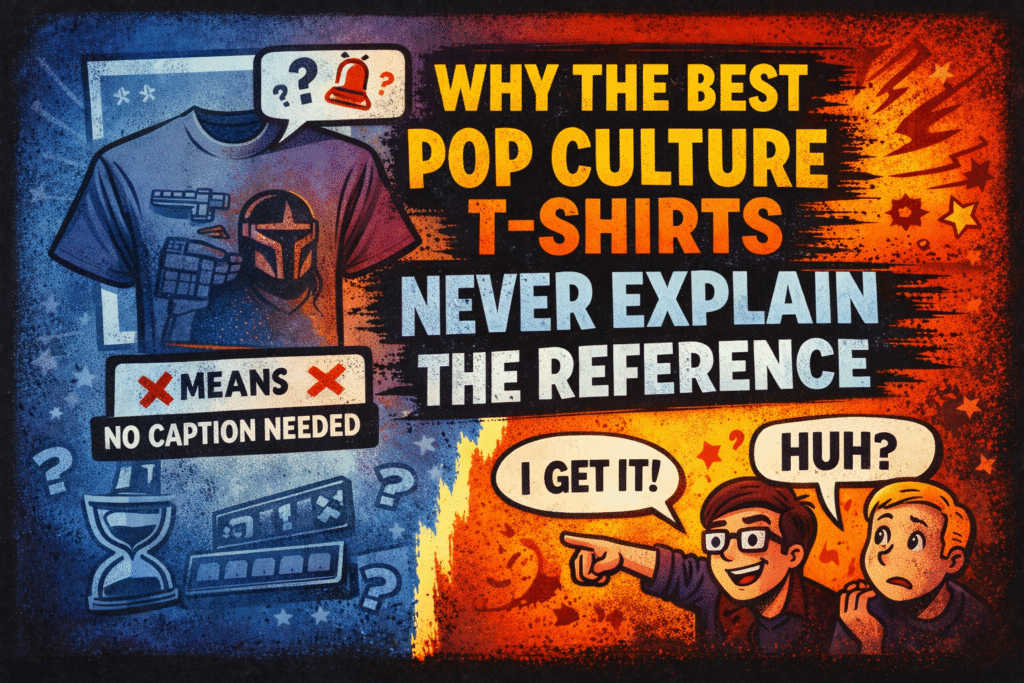
If a pop culture t-shirt has to explain itself, something already went wrong.
Real fans do not want a caption. They do not want a footnote. They do not want the joke spelled out in case someone else does not get it. The entire point of wearing a reference is knowing who will recognize it without help.
This is one of the clearest signals of design quality. The best shirts assume intelligence. They assume shared context. They trust that the right people will understand immediately.
Everyone else is allowed to miss it.
This idea sits at the core of why daily pop culture t-shirts still matter to real fans. A good design is not trying to reach the widest audience possible. It is trying to reach the right one. That is a much harder problem to solve.
Lazy pop culture merch usually fails in the same way. It overexplains. It leans on obvious imagery. It uses the safest possible reference and then amplifies it so no one feels left out. The result is something that technically references culture but does not participate in it.
Insider designs work differently.
They pull from moments, lines, symbols, or visual language that only make sense if you were already paying attention. There is no onboarding process. You either recognize it instantly or you keep walking. Both reactions are acceptable.
This is also why daily drops amplify quality when done correctly. As discussed in daily drops vs static catalogs and why fans get bored faster than brands expect, releasing one design per day forces restraint. There is no room for filler. Each idea has to stand on its own without explanation.
RIPT leans into this intentionally. Designs are built to reward recognition, not curiosity. The goal is not to teach someone about a fandom. The goal is to nod to people who are already inside it.
That approach creates a different kind of credibility. When someone notices your shirt and gives a small reaction, a look, a comment, a knowing laugh, that moment only happens because the design trusted them enough not to explain itself.
Check out our new Comparison Guide
That is not accidental. It is a design philosophy.
It is also why browsing the Daily Deals feels different from scrolling a generic catalog. You are not being introduced to ideas. You are being tested on recognition. Some days you pass. Some days you do not. Both outcomes are fine.
For fans who care deeply about their interests, that trust matters more than mass appeal ever could.